
Future Tropical Cyclones hazard dataset
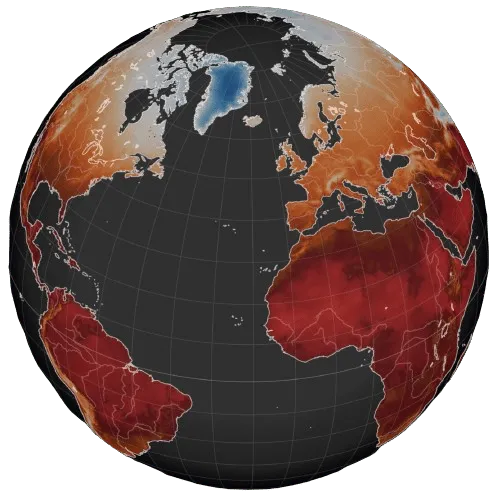
A global dataset at 0.1° resolution of three tropical cyclones indicators from four climate models under the Shared Socioeconomic Pathways (SSP5-8.5) scenario from the Intergovernmental Panel on Climate Change (IPCC) Sixth Assessment Report (AR6). The time coverage for historical (1980-2017) and near future (2015-2050) conditions.
Future Tropical Cyclones dataset specifications
Section titled “Future Tropical Cyclones dataset specifications”| Specification | Description |
|---|---|
| Experiment | CMIP6-HighResMIP |
| Scenarios | Shared Socioeconomic Pathways SSP5-8.5. |
| Climate models | The 4 models selected by the HighResMIP initiative: CMCC-CM2-VHR4, CNRM-CM6-1-HR, EC-Earth3P-HR, HadGEM3-GC31-HM |
| Spatial resolution | 0.1° x 0.1° Global |
| Temporal resolution | Conditions for two time periods: Historical (1980-2017) and near future (2015-2050) |
| Indicators | Tropical cyclones indicators are based on maximum 10-minute sustained wind speed at 10 metres statistics by return period from 1,000 random realisations. Available return periods are (years): 10, 20, 30, 40, 50, 60, 70, 80, 90, 100, 200, 300, 400, 500, 600, 700, 800, 900, 1000, 2000, 3000, 4000, 5000, 6000, 7000, 8000, 9000, 10000.
|
| Format | NetCDF, other formats possible depending on data volume |
Supplementary information
Section titled “Supplementary information”The Future Tropical Cyclones dataset provides return period estimates of maximum wind speeds from synthetic tropical cyclones, based on the STORM model (Synthetic Tropical cyclOne geneRation Model). This global dataset simulates 10,000 years of tropical cyclone activity under present-day climate using historical data from IBTrACS and environmental conditions from ERA5, consistent with the HighResMIP framework. Wind speed values are provided for 28 return periods from 10 to 10,000 years, enabling high-resolution risk assessments in cyclone-prone coastal regions. For more details and direct access to the data check the references:
Historical
Bloemendaal, N., de Moel, H., Muis, S., Haigh, I. D., & Aerts, J. C. J. H. (2020). Estimation of global tropical cyclone wind speed probabilities using the STORM dataset. Scientific Data, 7(1), 377. https://doi.org/10.1038/s41597-020-00720-x
Bloemendaal, N., de Moel, H.,; Muis, S; Haigh, I.D.; Aerts, J.C.J.H. (2023): STORM tropical cyclone wind speed return periods. Version 4. 4TU.ResearchData. dataset. https://doi.org/10.4121/12705164.v4
Future
Bloemendaal, N., de Moel, H., Martinez, A. B., Muis, S., Haigh, I. D., van der Wiel, K., Haarsma, R. J., Ward, P. J., Roberts, M. J., Dullaart, J. C. M., & Aerts, J. C. J. H. (2022). A globally consistent local-scale assessment of future tropical cyclone risk. Science Advances, 8(17), eabm8438. https://doi.org/10.1126/sciadv.abm8438
Bloemendaal, N.; de Moel, H.; Dullaart, J.; Haarsma, R.J.; Haigh, I.D. et. al. (2023): STORM climate change tropical cyclone wind speed return periods. Version 4. 4TU.ResearchData. dataset. https://doi.org/10.4121/14510817.v4
Tropical Cyclones dataset availability
Section titled “Tropical Cyclones dataset availability”The dataset is made available for convenience to our clients at no cost. The original data are accessible online but to make their use more practical we assembled the original single basins data files in one global file instead.
See all our climate projection data for the other hazards and the weather variables.